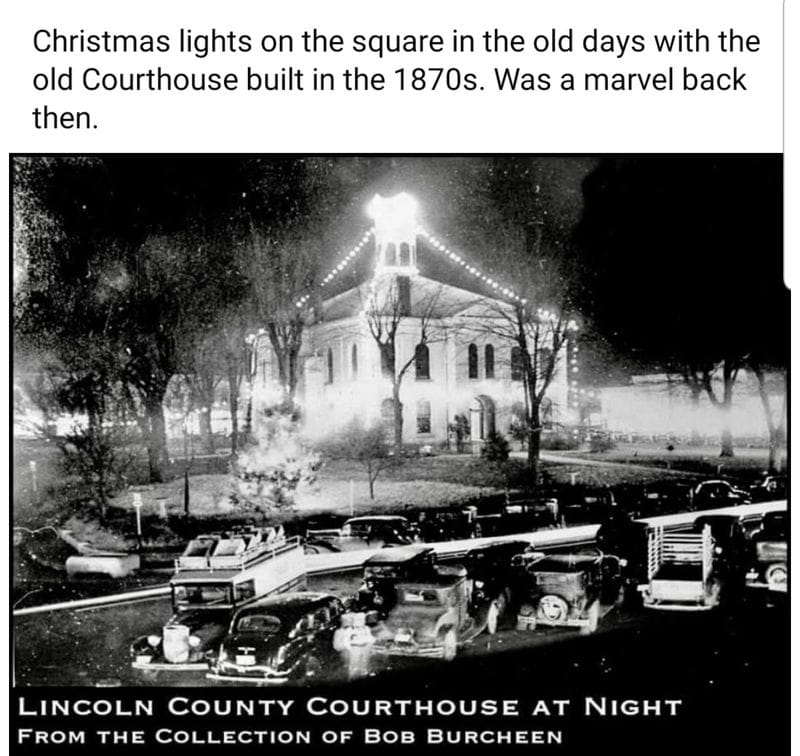
Fayetteville was perhaps the second county seat in the United States to be laid out by legal mandate with a courthouse square in its center. A stone plinth on the square’s Northeast corner marks the spot where in 1810 a pin was driven, and the committee of surveyors, including Hardy Holman, began cutting away at the vast can brake which covered all and platting the future town. The county court had acquired 100 acres from Mr. Ezekiel Norris—first by attempted chicanery and then by gradual purchase—for a county seat. The acreage, reserved for the courthouse, was cleared by a freed black man named Richard Sappington. A brick courthouse, completed in 1815, replaced a temporary log one, which stood on a corner of the public square. For the next 160 years, this courthouse and the four blocks surrounding it were the hub of political and economic life of Lincoln County. For its first half-century, the homes of leading citizens, the shops of essential craftsmen, a few stores and offices, taverns, and stock pens lined the square. Most of the buildings were log or frame structures.
By the 1850s, brick structures and more mercantile establishments appeared. During the occupation of Fayetteville, for two years of the Civil War, Union troops fortified the courthouse with a “bomb-proof” wall and used it for military headquarters. Under martial law, commerce almost ceased. In the decades after the war, each burst of prosperity and each economic slump is mirrored in the square as we see it today. In 1874, the graceful Italianate courthouse, which reflected Lincoln County’s first postbellum recovery, replaced the original 1815 building. For another near century, before its unfortunate demolition, this structure in its park-like setting dominated the square. The completion of the current courthouse signaled the close of the public square’s function as the economic center of Lincoln County.
In the 1870s enough capital was accumulated for the handsome structures on the North and East sides to rise. A disastrous national depression in the late 1870s halted further development. Local disasters—from the cyclone of 1850, which destroyed the first two-story commercial buildings, to two great fires in 1885, which consumed the entire West side excepting the Dragonfly Art Gallery (then, possibly the Tip Top Saloon). These disasters affected the gradual completion of a district of brick, two and three-story business houses with warehouses and professionals’ offices located on the upper floors. The oldest structures remaining are on the Southeast corners, the Northwest corner, the Southwest corner, and the North sides of the square.
Don’t forget that prior to 1903, saloons on three sides of the square were interspersed with dry goods stores, groceries, hardware businesses, tailoring establishments drugstores, banks, doctors, and lawyers’ offices—no lady walked unaccompanied across the square in those days.The corner building is antebellum, built by an early silversmith, Mr. Ringo. This side was the last to achieve its current form. In the 1880s and 90”s the center of the block was dominated by a large, two-story opera house—Bright Hall—where traveling theatre troupes and light opera companies performed. For well over a century, the corner, now occupied by O’Houlihan’s, was the site of markets and grocery businesses. One of our two independent newspapers, The Lincoln County News, first published in 1835, was located in the middle of this block for decades.
The Dragonfly Gallery is the oldest building on this side. During the 1880s and ’90s, it housed the Tip Top Saloon. Before 1900—“Fire House Hill”—was known as “Tip Top Hill.” Only after the fires of 1885, was the rest of the block completed. A department store (Terry’s) and the great Ready Bakery occupied the building where the Magnolia Mall is now. Butchers, barbers, varied merchants, and on the corner, the McKinney Drugstore filled the block.

At the turn of the century, a fraternal order, the Knights of Pythians, built this “Castle.” On the top floor was their meeting hall. Below were spaces rented to professionals and businesses and Fayetteville’s first “public library,” founded and operated for over half a century without any public funds by a women’s literary club—the Round Dozen. The ground and basement floors, of this building, were occupied by businesses and shops. There was a drug store located where the Main Street office is now.
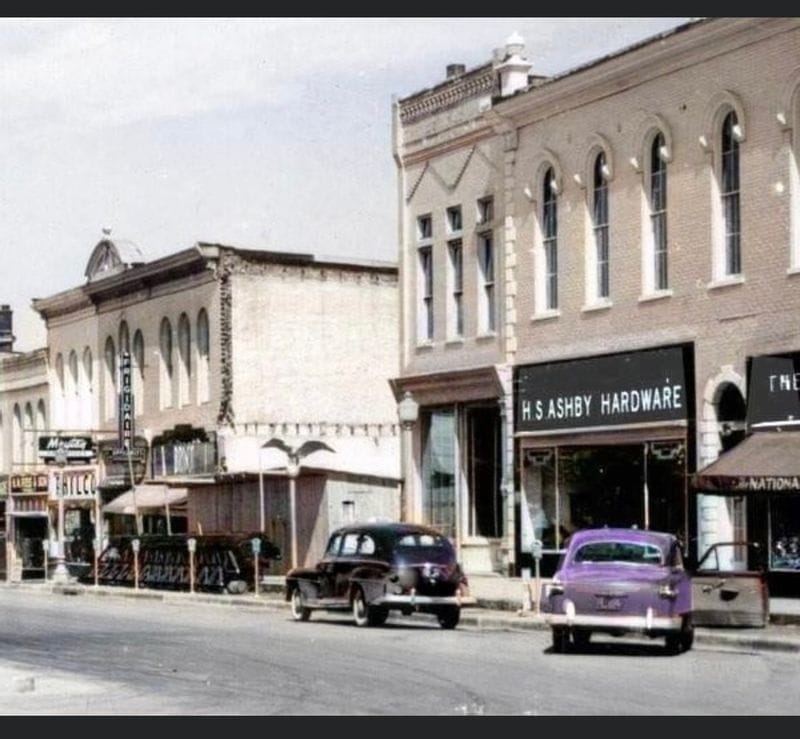
Wright’s Store: from the first decades of the 19th Century until the 1960s this has been the site of the leading dry goods store in Fayetteville. It was the site of the Douglas brothers' business in antebellum days. One brother migrated to Nashville where, in the 1850s, he was the city’s leading merchant. For decades it was Mr. Andy Wright’s store where everything from the finest imported laces to all manner of materials and readymade finery brought from New York could be had.
Ashby Hardware: This building was like others on the block, constructed in the first recovery boom after the Civil War. In the 1870s for nearly a century, a bank occupied the West side of this store. For over 130 years a hardware company has occupied the East side. One was the parent company of Benedict & Warren of Memphis, the Deep South’s largest wholesale hardware company.
Incidentally, the first telephone in Fayetteville rang in 1895, in what is now Massey Realty and was then the Hugh Douglas Smith Seed and Grain Company. Grocers, druggists, and jewelers long occupied this block.
Where Hair in Motion is located, was the stand of the first white barber (barber shops also had baths attached)—an anomaly and rarity prior to 1895. Later, around 1900, it became the office of the Fayetteville Electric Company, which furnished electricity to Fayetteville from 1889 until the late 1930s.
On this corner for over a century, jewelry businesses have operated. In the early 20th century, Mr. Broussard, a French-speaking native of Switzerland, not only sold beautiful things but also created exquisite settings of precious stones and did fine engraving. Later Becker's Jewelry, J.T. Wright, and Kennedy's Jewelers had businesses there.
The basement still has a fireplace which was operational at one time. The chimney was covered during modern construction. Dot Thompson, a past historian, was fascinated by the basement construction and very knowledgeable about construction of buildings from that time. She forwarded photos and information to a historian at MTSU who determined that some of the building materials were pre-Civil War and repurposed for the building.

Built in the 1850s, this was the home of Dr. Calvin McGuire, a prominent physician, and banker. Three generations of this family occupied the house, which has Bohemian glass sidelights. At least six generations of the family have been baptized in the Presbyterian Church. Serving in the Virginia campaigns of the Civil War, Dr. McGuire was Gen. Lee’s personal physician.
First Presbyterian Church: The congregation was organized in 1814. This building, the oldest public structure in Lincoln County, was completed in 1854. It replaced the first building, which was demolished in the cyclone of 1851. James Bright, one of Fayetteville’s early citizens and Surveyor General of Tennessee, bought acreage from Ezekiel Norris on the edge of the town and gave land for the Presbyterian Church and the town burial ground.
During the Civil War, this church was used by the Federal as a hospital and stable. There was originally a steeple, that was thought to have been damaged during The War. In an attempt to provide safety for the citizens, the men of the church decided to pull down the steeple before it fell on someone. Many oxen, mules, and horses were used, but the steeple held fast to its base. Unfortunately, the men dislodged it just enough to make it completely unsafe, and then the demolition project had to be completed.From this point, three of the few remaining antebellum houses of Fayetteville may be seen. To the right is an 1850s brick house whose massive colonnade dates from the 1930s. This home was occupied by the Holman family from the turn of the century for thee generations. To the left, on the corner, is another 1850s brick house built by John Morgan Bright for one of his daughters. It was occupied by the Higgins family and later the Reeses for succeeding decades. To the right beyond the stoplight is a mind-1850’s frame house—once the home of the Presbyterian minister of that era. The ancient brick smokehouse behind it was constructed from bricks burned in 1853 and 1854 for the church. The columns on its front were added in the 1940s, rescued from an old house facing demolition in Alabama.
Three houses command our attention—two having been occupied by the same family for generations. A fourth was occupied by a family distinguished for its contributions to Fayetteville, and its corner harbors a rare evergreen. The Cowan/Patrick home, built in 1909, by Mr. W. G. Cowan and his wife, Myra McGuire Cowan. Mr. Cowan was a prominent financier and Mrs. Cowan was a noted musician and the first organist of the Presbyterian Church. Their daughter, Mrs. J. C. Patrick, was born in the house and lives there today.
To the right is the Whitaker/Fulton house, which dates from the late 1840s. Its builders were the Whitakers, a family of educators. In the 1890’s Miss Isabel Whitaker and her sister, Ms. Allen built a schoolhouse on the southeast corner of the lot. For decades their school prepared the elite of Fayetteville for the rigors, of prep school and college. Their niece, Mrs. Maude Allen Fulton, was a teacher of speech and dramatics for decades. She added the massive Ionic portico in 1925.
On the corner is the Medearis house, which has been occupied by the same family for a century. Built in the late 1890s, by Dr. Warren, it was purchased in 1900 by Mr. W. D. Medearis. He was an original stockholder and long-time president of the old Fayetteville Electric Company, which furnished power to the city beginning in 1889 and continuing until the TVA forced it to close 50 years later.
Bonner/Lamb House: Col. Gordon, who came here from Philadelphia, PA, built this home in the 1840s. He sold it to antebellum Lincoln County’s wealthiest citizen and largest landowner, Dr. William Bonner. Col.Telford soon after built the house just to the East. Dr. Bonner was succeeded as owner by his daughter, Mrs. J. B. Lamb. The Lambs produced a line of distinguished lawyers. Descendants still own the house today.
This house, whose current appearance dates from the 1920s and 30s, was the one Col. Gordon built for his family who resided here for nearly a century. His granddaughter, Mrs. Claire Barnett Buchner, was not only a founding member of the (Sr.) Round Dozen who gave and maintained Fayetteville’s public library for over 50 years, was one of Tennessee’s leading suffragists. She was very prominent in Tennessee’s (by one vote) ratification of the 19th Amendment, which gave women the vote. Mr. and Mrs. Roy Reese gave the façade its current appearance. For many years this home was the home of another distinguished and public-spirited individual and his family, Mr. William R. Carter.
Dr. T. A. Patrick’s house: Beneath the beautiful, locally quarried, rough marble and Georgian revival exterior of the 1940s lies a frame house built in the 1850s by Judge Chilcoat, Lincoln County’s first judge. He was viciously murdered during the Civil War by “irregulars” who claimed to be loyal to the Union. Later this was the home of Dr. T. P. Holman whose wife, Selena Moore, was the National President of the WTU and very influential in securing the passage of the 18th Amendment. For many years hers was the only portrait of a woman to hang in our state capitol building. In the 1940’s Fayetteville’s beloved Dr. T. A. Patrick and his wife remodeled the house and had the stone façade installed.
Newsome House: Mr. Hubert and Miss Mildred Holman’s home. Build in the late 1890s by a prominent merchant of Fayetteville, Mr. J. L. Newsome, this turreted colonial revival house was presented by Mr. Hubert Holman to his bride, and the family occupied the house for many years. It is not the home of Dr. McKinney.
Thomison’s: This Victorian valentine house has been occupied and owned by the Thomison family for over a century. Its oldest section dates from 1865. The house as it currently appears was completed in 1890. The noted Judge Joseph Higgins and his family occupied the house for a few decades before the Thomisons.
The Gillespie/Buchannan House: The Victorian home of the Gillespies was built in 1872. Mrs. Gillespie was a prime supporter and participated n the funding and building of St. Mary Magdalene Episcopal Church. The house was sold to the Buchanan family and is still inhabited by descendants.
Left – Here are the first “spec” houses built in Fayetteville prior to the 1950s. In the middle 1920s, Mr. Hiller built two and planned a third. The crash prevented project completion and gave a side yard to the corner house.
Right – The Lamb/Rice/Warren house was the home of Fayetteville’s noted actress, Adnia Rice, and her mother. They lived here following Ms. Rice’s retirement from the state of New York. The other houses in this block were constructed between 1870 and 1910.
Church of Christ – In 1867, the recently organized Christian Church erected a brick meeting house. The great cyclone of 1890 demolished it, and an elegant gothic structure with two asymmetrical spires replaced it. In the early 1900s the Congregation became a Church of Christ. In 1952, the gothic church was destroyed by the cyclone. The current structure replaced it.
To the right, the Dance Studio, formerly the Rotary Building, was Fayetteville’s Baptist Church.
The Douglas House – North Elk and Washington. Built in 1894, as the townhouse for Mr. Hugh B. Douglas’ family, whose 1,400-acre farm lay east of Fayetteville, on the west side of the Elk River from Kelso. The elaborate interior millwork of the townhouse was made from lumber felled on the Douglas farm.